
When looking at freight tariffs, the base rate usually gets the first look.
But it only shows part of what a shipment actually costs.
Depending on the tariff, the following may be added:
- diesel and fuel surcharges
- tolls
- additional services
- seasonal surcharges
- other tariff-defined ancillary costs
These items can be complicated. They are often based on indices, tables, percentages, weight classes or individual agreements.
The decisive question is therefore not only: “What is our base rate?”
But also:
“Were all surcharges and ancillary services for each individual shipment calculated in accordance with the agreed tariff?”
This exact check can be automated with specialized freight invoice auditing software.
ShipCheck digitizes diesel and toll logic as well as prices for ancillary services, and can then calculate what the shipment should have cost according to the contract.
What are ancillary freight costs?
Ancillary freight costs are cost items charged in addition to the actual base freight.
Depending on the mode of transport and contract, they can include, for example:
- diesel and fuel surcharges
- toll costs
- additional services
- seasonal surcharges
- administrative fees
- other tariff-dependent items
Such costs are not automatically problematic.
Many surcharges are contractually provided for and reflect variable cost components.
For freight auditing, it is therefore not decisive whether a surcharge exists.
What matters is:
Was exactly the surcharge calculated that should have applied to this shipment according to the contract?
Why ancillary freight costs are harder to audit than a base rate
A base rate can be relatively simple in structure.
Surcharges often involve additional dependencies.
A diesel surcharge, for example, may depend on:
- which index applies
- which reference value was agreed
- which period is used
- which surcharge bracket is reached
- which percentage follows from that
- when a new table takes effect
A toll item may follow a different calculation logic.
An ancillary service may only be charged under certain conditions.
Therefore, it is not enough to simply look on the invoice for a line item called “Diesel” or “Toll.”
The software must be able to understand which tariff rule applies to the specific shipment.
Auditing diesel surcharges: which values must match?
Diesel or fuel surcharges are a typical example of variable ancillary freight costs.
The following points may be relevant when auditing:
- fuel index used
- agreed reference value
- reference period
- surcharge bracket
- percentage
- validity period
- application to the specific shipment
An error can already occur if only one of these components is applied incorrectly.
For example:
The right index is used, but the wrong month.
Or:
The right table is used, but a wrong percentage.
Or:
After a tariff change, an old surcharge table remains active.
With a small number of invoices, such cases can be checked manually.
With many shipments, however, a large number of individual calculations arise.
How software can automatically audit a diesel surcharge
For software to audit a diesel surcharge, the agreed logic must first be available in machine-readable form.
ShipCheck converts tariff information such as diesel formulas into a calculable contract model.
For a specific shipment, the following simplified process can then take place:
- The relevant tariff version is determined.
- The diesel rule applicable to the shipment is applied.
- The expected surcharge according to the contract is calculated.
- The target value is compared with the invoiced amount.
- A variance is made visible.
This no longer just checks:
“Is there a diesel surcharge on the invoice?”
But rather:
“Was this diesel surcharge calculated for exactly this shipment according to the agreed logic?”
Tolls and other surcharges work on the same principle
The same basic principle applies to tolls and other ancillary freight costs.
For each type of cost, it must be transparent:
- which rule was agreed
- for which transports it applies
- which amount or percentage is to be applied
- in which period the rule is valid
- what was actually invoiced
Only when this information is available in a structured form can an automatic target/actual comparison take place.
ShipCheck digitizes the following for this purpose, among other things:
- base tariffs
- weight and zone matrices
- diesel formulas
- toll logic
- prices for ancillary services
and converts them into a calculable tariff model.
Which errors can software detect in ancillary freight costs?
During automated auditing, different variances can become visible.
| Error type | What happens |
|---|---|
| Wrong diesel index | A different or outdated index is used than agreed in the tariff. |
| Wrong reference period | The right index is used, but the wrong month or reference period is applied. |
| Wrong percentage | The right type of surcharge is calculated, but with a deviating percentage. |
| Outdated surcharge table | After a tariff change, an older table continues to be used. |
| Unagreed surcharge | An additional item is invoiced even though it is not provided for in the stored tariff. |
| Incorrectly calculated ancillary service | An additional service is calculated differently than contractually agreed or applied to a shipment for which the relevant rule does not apply. |
ShipCheck identifies exactly these types of errors when auditing ancillary freight costs.
Why auditing at line-item level is important
An invoice can consist of numerous shipments and cost items.
Therefore, checking only the invoice total is not enough.
Example:
An invoice contains 300 shipments.
For 260 shipments, the diesel surcharge was calculated correctly.
For 40 shipments, however, a wrong surcharge bracket was used.
The total invoice amount says little about this at first.
Only checking the underlying line items makes the variance visible.
That is why the central unit of freight auditing is not just the invoice.
It is the individual shipment or cost item.
Why systematic surcharge errors are particularly relevant
The largest individual errors are not always the most interesting.
A small variance can become economically relevant if it repeats very frequently.
Example:
A surcharge on a single shipment is only a few euros above the target value.
That may hardly be noticeable.
However, if the same calculation logic is applied to hundreds or thousands of shipments, a systematic problem arises.
That is why ShipCheck distinguishes between individual and systematic variances and categorizes them by financial impact.
This allows a logistics team to see not only:
“Where are there variances?”
But also:
“Which variances repeat and which of them are financially particularly relevant?”
Why sampling can be problematic for ancillary freight costs
Manual freight auditing often comes down to sampling when invoice volumes are high.
That is understandable.
One person cannot check every single diesel, toll or ancillary service line item from thousands of shipments against complex tariff rules.
However, sampling creates a fundamental problem:
A systematic error does not have to occur on the invoice that happens to be checked.
Small recurring variances in particular can therefore remain undetected for a long time.
The advantage of automated auditing is therefore not only speed.
It lies in applying the same audit logic consistently to all relevant shipments.
Tariff digitization is a prerequisite for automated surcharge auditing
Software can only reliably audit ancillary freight costs if it can calculate the underlying agreements.
A PDF with a freight tariff is not automatically sufficient for this.
For example, a diesel rule must clearly state:
- which index is used
- how the reference value is defined
- which thresholds or brackets apply
- how a percentage is derived from that
- for which period the rule is valid
ShipCheck structures such tariff information and turns it into a calculable tariff model.
Only then can the software calculate the target costs of the shipment and compare them with the invoice.
Thus, tariff digitization is not a side function.
It is the foundation of automated freight auditing.
Why tariff versions are particularly important for surcharges
Variable surcharges change.
Tariff systems can also be updated.
This raises another important question:
Which rule applied at the time of the respective shipment?
If a new surcharge table applies from January, transports from December must not automatically be evaluated against this new table.
Conversely, an old rule must not continue to be applied to new shipments.
For a reliable audit, it must therefore be transparent which tariff version or surcharge logic was valid for which period.
This temporal allocation is an essential component of the audit model, especially for surcharges that change continuously.
Analyzing and auditing ancillary freight costs are not the same
With ancillary freight costs, there are two different questions.
Analysis
How are our surcharges developing?
For example:
- surcharge share
- diesel surcharges per shipment
- surcharges by carrier
- surcharges by lane
- development over time
Audit
Were these surcharges calculated in accordance with the agreed tariff?
For this, a target/actual comparison with the stored tariff rules is necessary.
ShipCheck combines both perspectives:
Structured transport data can be used for KPI and cost analyses, while freight auditing additionally compares invoiced items against the agreed conditions.
Which KPIs make sense for ancillary freight costs
In addition to the actual invoice audit, it makes sense to keep the development of ancillary costs visible.
Relevant KPIs can include:
- ancillary freight costs per shipment
- share of ancillary costs in total freight costs
- diesel surcharge per shipment
- surcharges by carrier
- surcharges by lane
- development of individual surcharge types over time
- number of detected variances
- financial value of detected variances
This makes it possible to distinguish, for example:
Are our ancillary freight costs rising in general?
or:
Is the change concentrated on specific carriers or lanes?
The shipment-level data base enables exactly this differentiation.
From anomaly to specific shipment
A dashboard may show, for example, that the surcharge share is rising for one carrier.
That is initially only a signal.
It becomes interesting when this development can be broken down further:
Surcharges total → Carrier → Lane → Shipment → Cost item
This allows the logistics team to investigate which specific transports are behind the change.
When a variance is found in freight auditing, it can additionally be checked what amount should have applied according to the tariff and what was actually invoiced.
This connects cost analysis and invoice auditing on the same granular data base.
Why ancillary freight costs should be monitored continuously
Ancillary freight costs often change less visibly than a large base-rate increase.
Individual changes in diesel, tolls or ancillary services can develop gradually.
Therefore, it makes sense not to look at these items only in a one-off cost analysis.
Their development should remain continuously visible.
The HDS experience behind ShipCheck is geared precisely to this: surcharges and ancillary costs should be checked regularly at shipment level.
Software makes this approach more scalable because new transport data does not have to be built into a new manual analysis every time.
What software does not answer about ancillary freight costs
One important limit should nevertheless remain clear.
Freight invoice auditing answers:
“Was what was contractually agreed calculated?”
It does not automatically answer:
“Is the agreed surcharge formula economically the best possible condition?”
An invoice can therefore be tariff-correct even though the underlying agreement is economically unfavorable.
This is not a weakness of invoice auditing, but a different question.
For ShipCheck, the relevant task is therefore clear:
to systematically check the correct application of the agreed tariffs and surcharge logic.
How ShipCheck audits ancillary freight costs
The process can be simplified as follows:
1. Tariff rules are digitized
Base tariffs, weight and zone matrices, diesel formulas, toll logic and ancillary service prices are converted into calculable rules.
2. Invoice and shipment data are structured
This allows the respective cost item to be assigned to a specific shipment.
3. Target costs are calculated
The software determines what the shipment should have cost based on the stored conditions.
4. Target and actual are compared
Invoiced costs are compared with calculated contract costs.
5. Variances are categorized
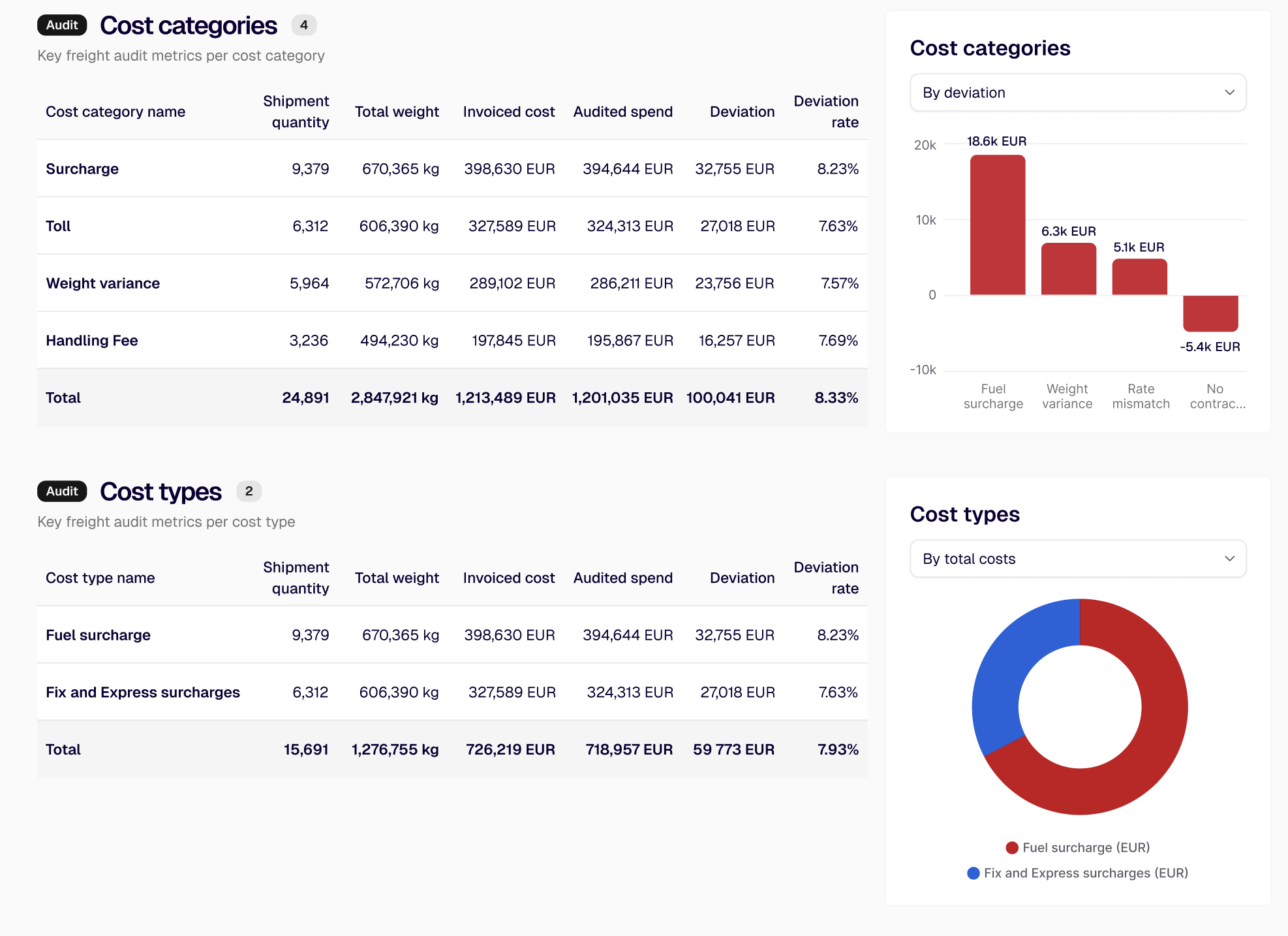
Errors can be made visible by type, repetition and financial impact.
This turns manual control of individual surcharges into a systematic audit across large shipment volumes.
Conclusion: ancillary freight costs should be not only visible, but auditable
The base rate is only one component of actual freight costs.
Diesel, tolls and other ancillary services can make up a substantial share of a shipment’s costs.
For reliable control, it is therefore not enough to know only the total surcharge amount.
What matters is:
Which surcharge rule applied to the specific shipment?
What should have been calculated according to the tariff?
What was actually invoiced?
Does a variance repeat systematically?
These exact questions can be automated with specialized freight invoice auditing software.
ShipCheck makes the underlying tariff rules calculable, checks cost items against the agreed conditions and makes variances as well as the development of ancillary freight costs visible.
Frequently asked questions
What are ancillary freight costs?
Ancillary freight costs are additional costs on top of base freight. They can include, for example, diesel and fuel surcharges, tolls, ancillary services and other tariff-dependent fees.
Why should ancillary freight costs be audited separately?
Because surcharges can follow their own tariff and calculation logic. A stable base rate therefore does not automatically mean that the total costs of a shipment remain stable.
How can software audit a diesel surcharge?
The contractually agreed diesel rule is stored as a calculable tariff logic. The software can then calculate the expected surcharge for a shipment and compare it with the actually invoiced value.
Which errors can occur with freight surcharges?
Typical examples are incorrect fuel indices, incorrect reference periods, incorrect percentages, outdated surcharge tables, unagreed surcharges and incorrectly calculated ancillary services.
Why are systematic surcharge errors particularly relevant?
Because small variances can repeat across many shipments. A low error per transport can therefore add up to a significant financial effect.
Can software audit tolls automatically?
Yes, provided the agreed toll logic is stored as a calculable tariff rule and the shipment and invoice data required for the audit are available.
What is the difference between analyzing and auditing ancillary freight costs?
Analysis shows, for example, how surcharges develop by carrier, lane or period. Auditing additionally compares the invoiced values with the contractually agreed target costs.
Can a freight invoice be tariff-correct and still economically unfavorable?
Yes. Invoice auditing checks whether the agreed conditions were applied correctly. It does not automatically evaluate whether those conditions are optimal in the market.
Why must freight tariffs be digitized for automated auditing?
Because software must not only read the text of a tariff document, but be able to calculate the rules it contains. This includes weight classes, zones, diesel and toll logic, and ancillary service prices.