Tender Software for Freight Forwarders
The tendering tool for freight tenders — break down offers by mode, route and cost components.
Freight forwarders often submit one total price (= budget) in tenders — a black box designed to protect their margin.
See exactly where each forwarder is strong or weak — and negotiate with clarity.
A Tendering Platform Built for Logistics Leaders
How ShipCheck's Tendering Tool Changes the Game
Breakdown by Trade Lane
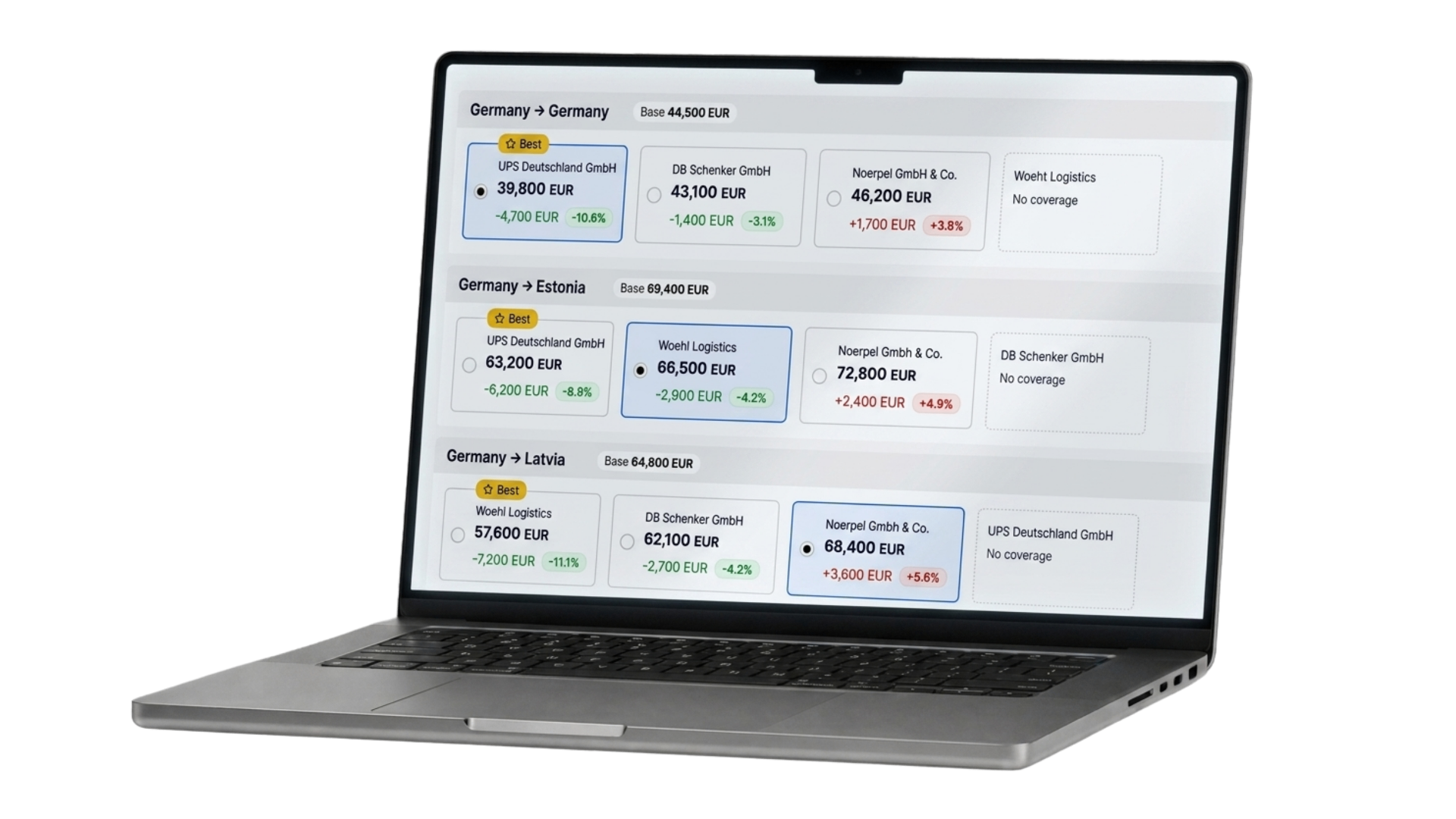
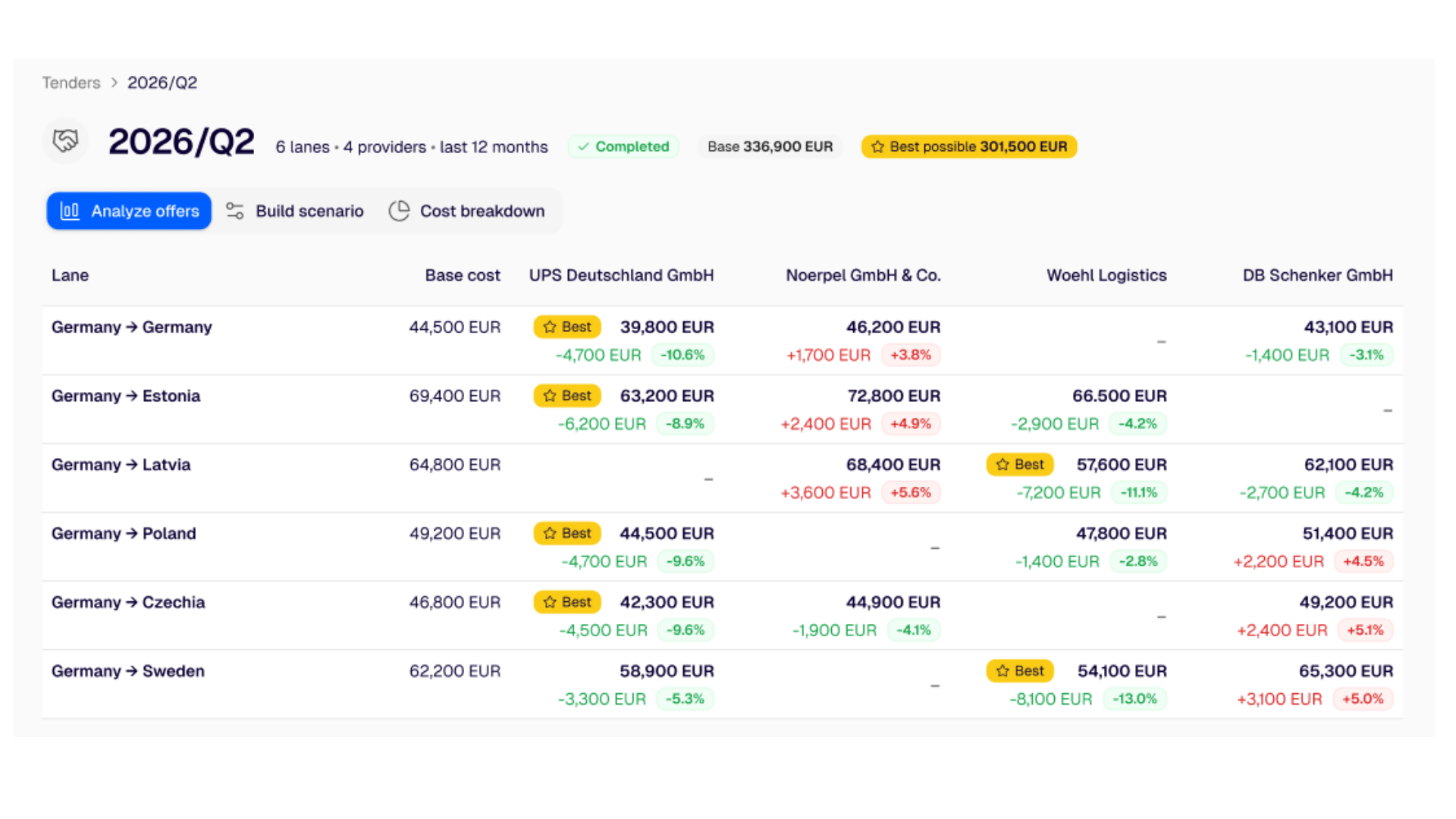
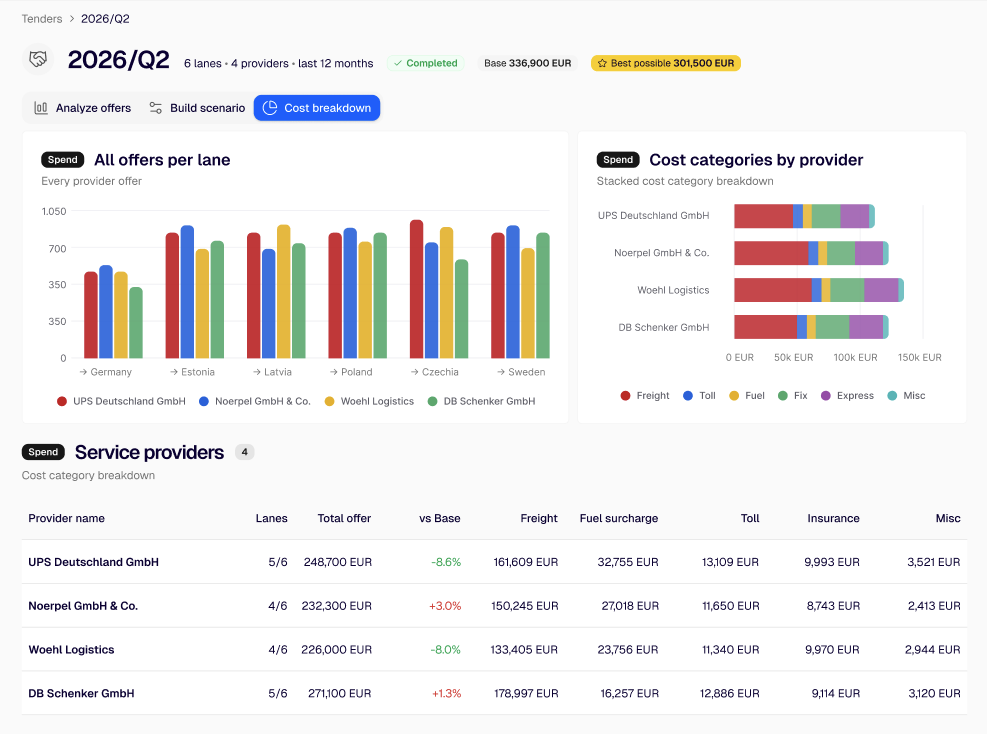
Instead of one opaque price, ShipCheck presents offers by trade lane with drill-down to individual shipments. You instantly see which lanes or modes eat up the budget.

Include Revenue Forecast
Apples-to-apples comparison
With ShipCheck, you calculate tender offers not only based on past volumes but can also factor in sales forecasts. This lets you calculate logistics costs based on projections with actual tender prices — providing planning and budget certainty while preventing surprises.

Negotiate Smarter
Turn transparency into leverage
Knowing which forwarder performs well or poorly on which trade lanes, weight brackets, or distance ranges gives you real negotiation power — saving 5–15% through negotiations and optimized award decisions.

These companies trust HDS and ShipCheck





















How It Works
See the Real Costs
Compare carrier offers using your actual shipment data — not averages or assumptions/budgets.
You see what each offer would actually cost you — based on how you ship today or a forecast of future volumes.
Test "What If" Scenarios
Simulate future situations before they happen.
For example: fuel price changes, volume growth, new lanes, or different carrier mixes — and see the cost impact instantly.
Decide Who Gets Which Shipments
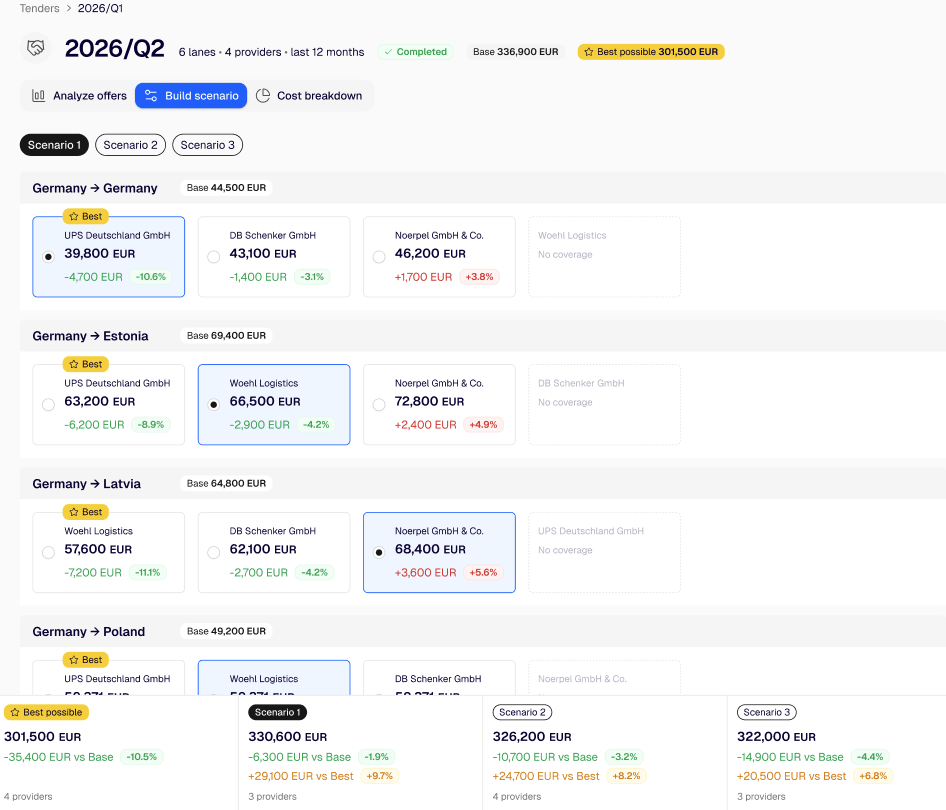
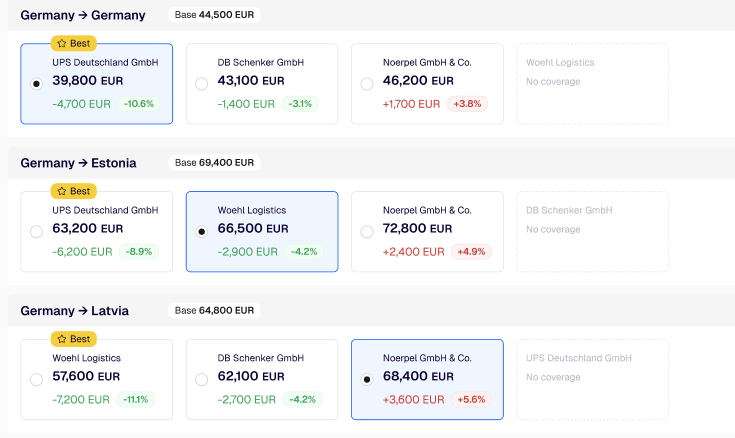
Create and compare different ways of assigning shipments to carriers.
ShipCheck automatically creates a best-case award scenario. Create as many additional options and alternatives across all service providers and trade lanes. Carrier A gets domestic shipments, Carrier B gets international lanes, Carrier C handles express shipments. Each option is an award scenario — a concrete plan showing who ships what and at what total cost.
See Tendering in Action
In just two minutes, learn how ShipCheck turns your next tender into a data-backed decision.
No more black boxes. See how transparency works.
Tendering's Hidden Problem
When shippers issue a tender, freight forwarders often reply with a single total number, the "budget." That one figure often mixes not only transport costs but also surcharges and different service types — leaving logistics teams guessing. ShipCheck changes that by breaking every quote into its components.
Only one final price, no insight into how it's built.
The "total" hides each mode, route, and surcharge. You can't tell which part inflates the cost.
ShipCheck visualizes every price component on every trade lane for every tender participant — road, sea, air — and calculates comparable KPIs.
Manipulated projections — based on last year, not reality.
Forwarders quote using outdated shipment data, modeling offers that look cheap to win — and profit later.
ShipCheck uses live data and benchmarks to flag unrealistic assumptions before tariffs are signed.
No visibility — no fair comparison.
Each provider calculates prices differently, so side-by-side totals mean nothing.
ShipCheck normalizes all offers into one structure, making comparisons truly apples-to-apples.
No leverage — decisions made blind.
Without transparent data, procurement can't question or negotiate effectively.
ShipCheck gives you the data to challenge forwarders with facts — not assumptions.
From the ShipCheck blog
Practical insights on freight costs, tariffs and logistics controlling.





Stop Negotiating in the Dark
Old Way
Negotiating in the Dark
- Service providers calculate their prices based on volume structures and deliver one number: the budget.
- Only budgets are compared and can be negotiated. Detailed information on how prices behave with volume changes or shifts is often unavailable.
- Decisions are made based on budget figures — even minor future structural changes can lead to massive cost increases.
Reality
You negotiate without the detailed knowledge your forwarder has — and your counterpart knows it.
ShipCheck Way
Negotiating with Transparency and Knowledge
- Lane-level walk-away prices calculated upfront
- All offers normalized and objectively comparable
- Sales forecasts calculated and matched against tender prices
- Scenarios simulated before any discussion starts
Outcome
You negotiate on equal footing like a pro: with complete information per shipment on all advantages and disadvantages in price and performance.