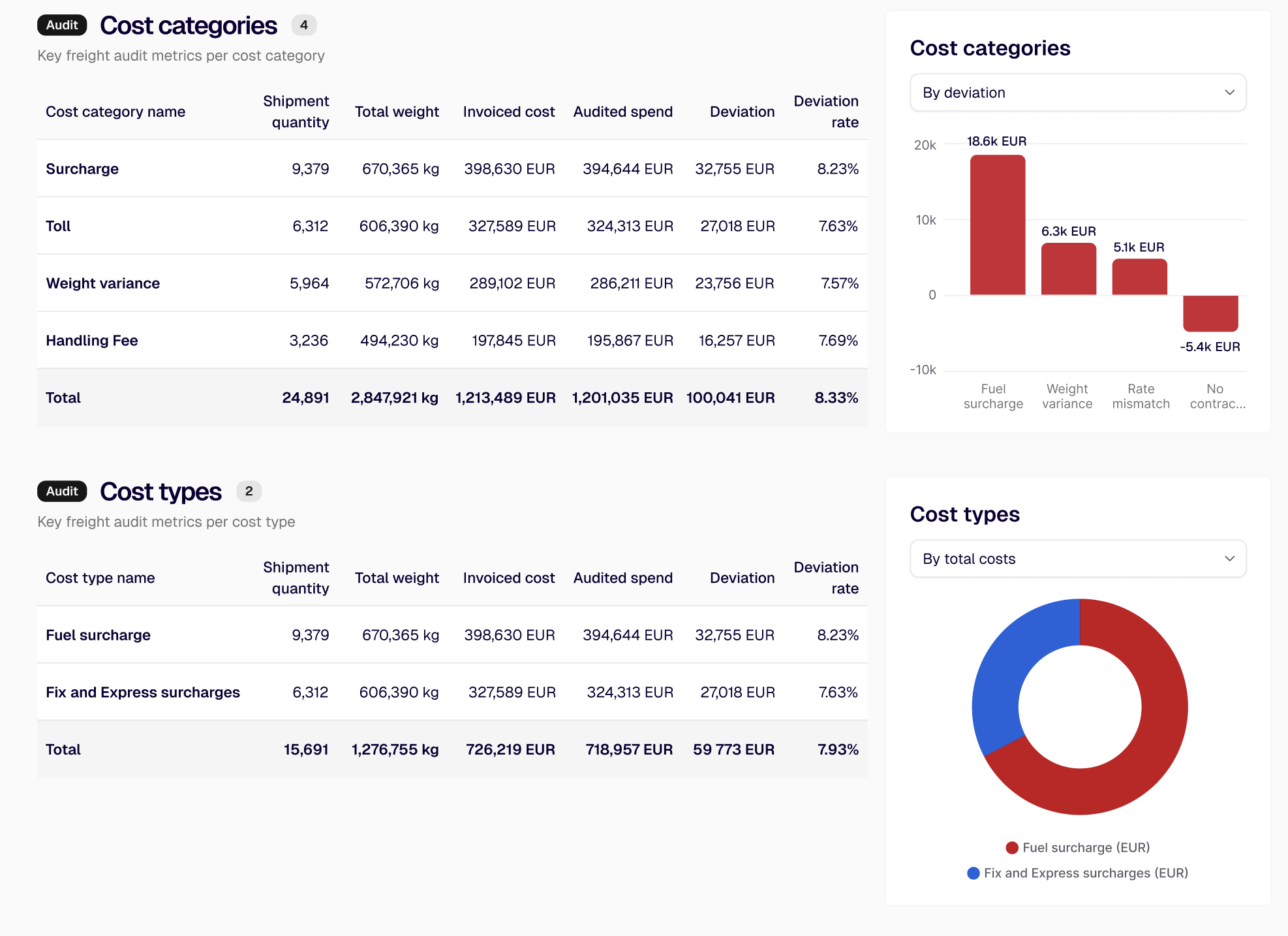
Auditing carrier invoices sounds simple at first: compare the invoice with the agreed tariff, identify variances and raise a claim where necessary. In practice, the task is considerably more complex.
Freight contracts often consist of tariff tables, weight and zone systems, fuel surcharges, toll rules, ancillary services, discounts and other special conditions. At the same time, individual invoices can contain hundreds or thousands of line items. A complete manual audit is hardly realistic with such structures.
Freight audit software therefore automates the comparison between agreed tariffs and the costs actually charged. Instead of checking only individual invoices on a sample basis, every shipment and every relevant invoice line item can be systematically audited.
This is exactly the approach behind ShipCheck: the software digitizes tariff structures and compares every invoice line item with the agreed conditions.
What is freight audit software?
Freight audit software is a specialized application that allows companies to automatically check transport and carrier invoices for compliance with the applicable tariffs. It brings together two data worlds.
1. What was agreed?
This includes, for example:
- base tariffs
- weight brackets
- zones
- lanes
- fuel surcharges
- tolls
- ancillary services
- discounts
- special agreements
2. What was actually charged?
The software reads the carrier invoice or the underlying shipment data and determines which costs were invoiced per shipment. The two are then compared.
With ShipCheck, freight contracts, appendices and tariff matrices are digitized, for example. Base tariffs, weight and zone matrices, fuel formulas, toll logic and prices for ancillary services are converted into a machine-readable tariff model.
The system can then calculate what a specific shipment should have cost according to the contract and compare that value with the amount actually invoiced.
Why is auditing carrier invoices so difficult?
The problem lies less in the individual invoice than in the combination of volume and tariff complexity. A company may use multiple carriers, each with different structures:
- invoice formats
- tariff models
- terminology
- surcharge logic
- weight brackets
- billing structures
Even a single freight contract can therefore contain thousands of possible calculation paths.
That is also why HDS does not fundamentally analyze logistics costs using aggregated totals alone. Shipment-level analysis including ancillary freight costs is decisive.
A total can answer the question “How much did we pay for freight?” – but it does not answer: “Was every individual shipment billed correctly?”
How does automated freight invoice auditing work?
A professional audit process can generally be divided into four steps.
1. Digitize tariffs and contracts
First, the tariff conditions must become machine-calculable. This can include:
- freight contracts
- tariff tables
- surcharge tables
- appendices
- special agreements
At ShipCheck, AI helps extract tariff logic from the documents. The tariffs created are additionally checked by specialists. This is an important step: an automated invoice audit can only be as accurate as the tariff model against which it is run.
2. Import carrier invoices and shipment data
Next, the actually billed data is required. For a shipment-level cost analysis, HDS uses information such as:
- weight
- lane
- service provider
- surcharge line items
- invoice data
- shipment data
Existing contracts, tariff structures and information on locations and freight flows also form part of the data basis. ShipCheck can capture carrier invoices, credit notes and corresponding data imports and consolidate them into a central data structure.
3. Audit every shipment against the tariff
The actual freight audit now takes place. The software determines, for example:
- Which carrier handled the shipment?
- Which lane was used?
- Which weight was billed?
- Which tariff bracket applies?
- Which service was used?
- Which surcharges apply?
- Which discounts apply?
It then calculates what the shipment should cost according to the stored tariff. ShipCheck compares every invoice line item with the digitized tariff and also takes dynamic surcharges into account.
4. Identify variances and raise claims
If a difference between expected and actual costs is identified, it is shown. This turns an abstract suspicion into a concrete statement: Shipment X should have cost EUR 184 according to the tariff, but EUR 203 was actually invoiced.
Variances can then be categorized by type and financial effect and prepared for claims.
Which errors can freight audit software identify?
A wide range of variances can occur in carrier invoices.
Incorrect base freight
The wrong tariff bracket or an incorrectly applied base tariff can cause the base freight itself to be calculated incorrectly.
Incorrect fuel surcharges
Fuel surcharges often change regularly. Errors can arise, for example, when:
- the wrong index is used,
- an outdated table is applied, or
- the wrong percentage is charged.
Incorrect weight or zone
Assigning a shipment to the wrong weight bracket or tariff zone also changes the invoice amount directly.
Unagreed ancillary services
Carrier invoices often contain additional services and fees. Software can identify whether a charged ancillary service was actually agreed in the tariff or was relevant to the specific shipment.
Missing discounts
The reverse can also happen: a contractually agreed discount is not applied.
Duplicate billing
Duplicate invoices, shipments billed twice or repeated line items can also be identified automatically.
ShipCheck includes precisely these categories in its freight audit: base freight errors, fuel surcharges, weight and zone variances, ancillary services, missing discounts, duplicate billing and tariff violations.
Why are sample checks not enough for freight invoice auditing?
Many companies audit carrier invoices manually or review only selected invoices. This is understandable: fully checking complex tariff models manually would require an enormous amount of time.
The statistical problem is obvious, however: anyone who checks only a small proportion of invoices can only identify errors within that proportion.
Systematic billing variances are particularly problematic. A one-off error of EUR 30 is annoying. An incorrectly applied tariff rule that creates EUR 30 of additional cost on each of thousands of shipments is an entirely different problem.
That is exactly why the distinction between individual and systematic errors matters. ShipCheck categorizes variances accordingly and enables line-item-level auditing rather than isolated sample checks.
Why should freight auditing take place at shipment level?
Shipment-level analysis is relevant not only for invoice auditing. It is a fundamental component of professional logistics cost analysis. HDS therefore evaluates costs according to its methodology at shipment level – including ancillary freight costs.
The reason is simple. Consider two lanes: costs on Lane A fall by 10%, while costs on Lane B rise by 10%. In aggregate, the result can look like stable cost development. Operationally, however, the two areas have moved in completely different directions.
The same applies to surcharges, weight brackets or individual carriers. The more heavily data is aggregated, the more easily such differences disappear in the average.
A shipment-level data basis, by contrast, enables drill-down: total costs → carrier → lane → shipment → cost item. This not only reveals billing errors, but also creates a stronger basis for freight cost controlling and later negotiations.
A correct freight invoice does not automatically mean optimal freight costs
This is an important limitation of every traditional freight invoice audit. Software can determine: “The carrier charged exactly what is stated in the contract.” But that still does not answer: “Is this contract economically good?”
A fuel surcharge that has been calculated correctly according to the tariff can still be based on a disadvantageous surcharge formula. This is the dividing line between freight invoice auditing and market benchmarking or logistics cost optimization.
HDS also distinguishes between shipment-level analysis of existing costs and the question of whether the conditions reflect the current market. For market comparison, HDS uses its own quotation database containing real offers and tariffs from ongoing and completed projects.
The two questions should therefore be viewed separately:
- Freight invoice audit: Was billing correct according to the contract?
- Market benchmarking: Is the contract itself still market-competitive?
Both can reveal cost potential, but in different ways.
Why ancillary freight costs are particularly important
When auditing freight costs, the focus should therefore not be only on base freight. HDS describes ancillary freight costs as a frequently underestimated area. Under its project methodology, these costs are examined per shipment because additional margins for the service provider can remain hidden in a comparison of base freight alone.
They can include, for example:
- fuel surcharges
- tolls
- additional services
- seasonal surcharges
- administrative line items
- other tariff-dependent ancillary costs
For freight audit software, this means checking only the base rate is not sufficient. The full tariff model must be represented.
Manual freight invoice auditing vs. software
| Manual audit | Freight audit software |
|---|---|
| Often sample checks | Full audit possible |
| High time requirement | Automated comparison |
| Manual tariff calculation | Tariffs stored in machine-readable form |
| Different carrier formats | Data is normalized |
| Errors must be searched for | Variances are automatically flagged |
| Difficult to scale | Large data volumes can also be audited |
| One-off audit | Continuous control possible |
The greatest benefit therefore does not lie only in saving working time. Software changes the audit approach: an occasional review of individual invoices can become systematic control of the entire freight billing process.
From invoice auditing to ongoing cost control
Automated freight auditing has another advantage. Once carrier invoices and shipment data are structured, they can also be used for ongoing logistics controlling.
ShipCheck, for example, combines invoice, TMS and ERP data and calculates costs including:
- per shipment
- per route
- per carrier
- per kg
This makes trends and cost variances visible. It also reflects the fundamental HDS logic: cost efficiency should not be checked only once. Surcharges and ancillary freight costs should be monitored regularly at shipment level because cost increases can develop relatively unnoticed in these areas.
Freight invoice auditing therefore moves from being a reactive control task to a continuous component of freight cost management.
What should you look for in freight audit software?
Companies that want to audit carrier invoices with software should pay particular attention to whether the system can:
- represent complex tariffs and tariff matrices,
- account for fuel and other variable surcharges,
- audit invoices at shipment or line-item level,
- process different carrier formats,
- structure data from invoices,
- automatically calculate expected costs,
- categorize variances,
- make systematic errors visible,
- document claim amounts, and
- make the data usable for broader freight cost controlling.
The decisive point is not simply whether an invoice can be digitized. What matters is whether the software can determine what the specific shipment should actually have cost according to the contract.
Freight invoice auditing with ShipCheck
ShipCheck was developed on the basis of the working methods and logistics cost expertise of the HDS International Group. A central principle of this methodology is therefore also reflected in the software: freight costs are not considered only as an aggregated total, but are broken down to the individual shipment and invoice line item.
ShipCheck digitizes freight contracts and tariff logic, processes carrier invoices and automatically compares the costs actually invoiced with the agreed conditions. Variances are made visible and can be used as the basis for claims against the relevant logistics service provider.
This turns a manual or sample-based freight audit into systematic, software-supported control of freight costs.
Frequently asked questions about freight audit software
What is freight audit software?
Freight audit software automatically compares the costs actually charged on a carrier invoice with the contractually agreed tariffs and conditions. Variances can therefore be identified systematically.
Can carrier invoices be audited automatically?
Yes. The prerequisite is that both the invoice or shipment data and the relevant tariff conditions can be represented digitally. The software can then calculate the expected cost of a shipment and compare it with the invoiced amount.
What data is required for freight auditing?
Typically, carrier invoices or shipment data as well as the corresponding freight contracts and tariff structures are required. For a precise audit, data such as lane, weight, service provider and surcharge line items is particularly relevant.
Which errors can freight audit software identify?
Examples include incorrect base tariffs, faulty fuel surcharges, incorrect weight or zone assignments, unagreed ancillary services, missing discounts, duplicate billing and other deviations from the agreed tariff conditions.
Why is manual auditing of carrier invoices often insufficient?
Complex tariff structures can contain thousands of possible calculations. With large invoice volumes, a complete manual audit is therefore difficult to scale. Sample checks can also miss systematic variances outside the invoices that were reviewed.
Does freight audit software also check whether a tariff is market-competitive?
Not necessarily. A traditional freight audit primarily answers whether billing was carried out according to the agreed conditions. Whether those conditions are attractive compared with the current market is a separate benchmarking or optimization question.
What is the difference between freight auditing and freight cost controlling?
Freight auditing focuses on the comparison between invoice and tariff. Freight cost controlling additionally examines the development and structure of costs, for example by carrier, lane, period or shipment.
Frequently asked questions
What is freight audit software?
Freight audit software automatically compares the costs actually charged on a carrier invoice with the contractually agreed tariffs and conditions. Variances can therefore be identified systematically.
Can carrier invoices be audited automatically?
Yes. The prerequisite is that both the invoice or shipment data and the relevant tariff conditions can be represented digitally. The software can then calculate the expected cost of a shipment and compare it with the invoiced amount.
What data is required for freight auditing?
Typically, carrier invoices or shipment data as well as the corresponding freight contracts and tariff structures are required. For a precise audit, data such as lane, weight, service provider and surcharge line items is particularly relevant.
Which errors can freight audit software identify?
Examples include incorrect base tariffs, faulty fuel surcharges, incorrect weight or zone assignments, unagreed ancillary services, missing discounts, duplicate billing and other deviations from the agreed tariff conditions.
Why is manual auditing of carrier invoices often insufficient?
Complex tariff structures can contain thousands of possible calculations. With large invoice volumes, a complete manual audit is therefore difficult to scale. Sample checks can also miss systematic variances outside the invoices that were reviewed.
Does freight audit software also check whether a tariff is market-competitive?
Not necessarily. A traditional freight audit primarily answers whether billing was carried out according to the agreed conditions. Whether those conditions are attractive compared with the current market is a separate benchmarking or optimization question.
What is the difference between freight auditing and freight cost controlling?
Freight auditing focuses on the comparison between invoice and tariff. Freight cost controlling additionally examines the development and structure of costs, for example by carrier, lane, period or shipment.